NEW PRICES - Shipping 14.99€ Free shipping from 90€ to Europe (70€ to Spain peninsula)

These are the magic ingredients of our delicious fermented "Karmages".

What are lupins?

Lupins belong to the legume family (legumes) and are related to lentils, beans, and chickpeas 

Lupins contain four times more protein than chickpeas.
Their cultivation prevents soil depletion.
They contain three times more iron than kale.

In our case, lupins are produced on the peninsula by a small family of growers who are exclusively dedicated to growing this superfood. Lupins are rich in fibre and very healthy.

Lupins are rich in fibre

which makes our Karmages great allies for maintaining the balance of the microbiota and our intestinal health. Packed with fibre, lupins have great satiating power while being disproportionately low in calories.

Lupins are a very healthy legume known to alleviate the symptoms of diabetes, high cholesterol, hypertension, colon cancer, anaemia, and constipation. Their nutrition also plays an important role in maintaining bone and skin health, combating the oxidative effect of free radicals, and strengthening the immune system.

Lupins are mainly composed of protein (38%), fibre (25%), and slow-release carbohydrates (24%). They are also rich in vitamin B1 and minerals such as zinc and magnesium. They also stand out for their low fat content, which is mainly unsaturated (healthy fats).

Protein plays a major role in the growth of new cells, supports tissue repair, and maintains the function of the immune system.

Dietary fibre contributes to cardiovascular health and may also help with weight control.

Vitamin B1 is essential for the metabolism of carbohydrates and fats, as well as the maintenance of the central nervous system.

Zinc and magnesium are important minerals for bone and cartilage health.

Helps lower cholesterol

May alleviate symptoms of diabetes

Helps reduce high blood pressure and hypertension

Cardioprotective support

Helps in weight loss

Possess antioxidants and counteracts free-radical activity

Helps maintain intestinal health

Helps reduce the risk of colon cancer

Promotes bone health

Excellent source of protein

Important role in immune system health

Prevents skin ageing and promotes the appearance of a healthy, glowing complexion

Alleviates the symptoms of anaemia

Relieves constipation

Properties of the fair-trade cashew nuts

Cashew nuts have a fatty acid profile (1:2:1 ratio); and they’re rich in tryptophan, copper, magnesium, iron, zinc, phosphorus, and selenium. Their total amount of fat is lower than almonds.

Cashews have also been proven to help reduce high cholesterol and triglyceride levels, improve sleep induction and sleep quality, lower the risk of cancer, maintain bone and muscle health, combat the oxidative effect of free radicals, and promote hair and nail health.

For every 100 grams, we find 570 calories, 18 grams of proteins, 32 grams of carbohydrates and about 2 grams of fibre. Cashews are also rich in group B vitamins (B1, B2, B3, B5, B6, and B9) among others, as well as minerals such as magnesium, potassium, phosphorus, and zinc, not to mention unsaturated fatty acids.

They are mainly composed of proteins (38%), fibre (25%), and slow-release carbohydrates (24%). They are also rich in vitamin B1 and minerals such as zinc and magnesium. They also have low fat content, which is mainly unsaturated (healthy fats).

Cashews are an excellent source of magnesium, aid muscle relaxation and neuromuscular transmission, and support physical activity.

Contrary to popular belief, cashew nuts have great health benefits. Not only do they have a lower fat content than most other nuts, but approximately 82% of their fat is unsaturated, and about 66% of this unsaturated fatty acid content is heart-healthy monounsaturated fats, similar to those found in olive oil.

Copper and magnesium, two minerals that are in short supply in many people’s diets, are found in abundance in cashews.

Helps lower cholesterol and triglycerides levels

Helps maintain strong, healthy bones and muscles

Helps reduce high blood pressure and hypertension

Calming and sleep-inducing

Helps reduce the risk of certain cancers

Source of antioxidants

Promotes healthy hair and nails

Fermentation: the fulcrum of our karmages recipes, promoting a high concentration of probiotics.

Fermentation is key process in making our recipes, and this process is what gives our products their unique flavour profiles.

Fermenting is the age-old biological process of altering, transforming, and preserving food. It’s natural and provides probiotics and minerals.

There are many fermented products we consume on a regular basis, such as wine, beer, and bread. The benefits of fermentation are:

Nutritional enhancement and creation of unique micronutrients
Detoxification and transformation of antinutrients into nutrients
Reduces the risk of developing certain diseases
Food becomes resistant to microbial spoilage and development of food toxins
Enriches ingredients with minerals and probiotics (good for gut flora and the immune system)
Modifies the taste of the original ingredients, in many cases improving their nutritional value

For fermented food to benefit your health, you need to ensure your fermented plant-based cheese has not been pasteurised. A product may be labelled as “fermented”, but if it’s undergone high heat treatment such as sterilisation or pasteurisation, it loses much of its probiotics, vitamins, and minerals.

If you want to know more about fermentation, we invite you to take a look at one of our fermented Karmage recipes by following this link or visit our workshops in Barcelona.

For fermented food to benefit your health, you need to ensure your fermented plant-based cheese has not been pasteurised. A product may be labelled as “fermented”, but if it’s undergone high heat treatment such as sterilisation or pasteurisation, it loses much of its probiotics, vitamins, and minerals.

If you want to know more about fermentation, we invite you to take a look at one of our fermented vegan cheese substitute recipes by following this link or visit our workshops in Barcelona.

Using a vegan starter culture: what are they?

We use Lactobacillus acidophilus (one of the most common types of probiotics) and Koji: these are vegan starter cultures. The fact that it is called Lactobacillus doesn’t mean that it contains lactose. A vegan starter culture is one which has been cultivated on a plant strain. Starters such as Penicilium roqueforti (a common fungus) can be vegan or non-vegan depending on their cultivation process.

The most commonly used starters for the production of vegan specialities are the same commonly used for cheese:

  • Koji, present in miso
  • Lactobacillus bulgaricus
  • Lactobacillus acidophilus
  • Penicilium roqueforti
  • Penicillium camenberti
  • Geotrichum candidum

NUTRITIONAL VALUE
The nutritional table
of a Veggie Karma Karmage

(with the most important nutrients)
Nutritional value
Energy (Kcal) 410
Protein (g)18,4
Carbohydrates (g)24,2
Vit C (mg)9,7
Fibre (gr)6,9
Vit A (mcg)4,9
Folate (mcg)118,5
Niacin (mg)1,8
Per /100Gr
Vit C (mg)1,4
Calcium (mg)9.4
Iron (mg)3,5
Potassium (mg)470,7
Magnesium(mg)137
Phosphorus (mg)354
Selenium (mg)13
Zinc (mg)3

Comparison between animal cheese and vegan Karmages

We wanted to make a comparison between our Karmage versus an animal-derived cheese, so that you can see clearly the nutritional quality of our Veggie Karma cheeses.

As we are not allowed anymore to make comparison with cheese, we have changed this content and will exclusively focus on our products.

PROTEIN

20gr. per 100gr. of semi-cured cheese

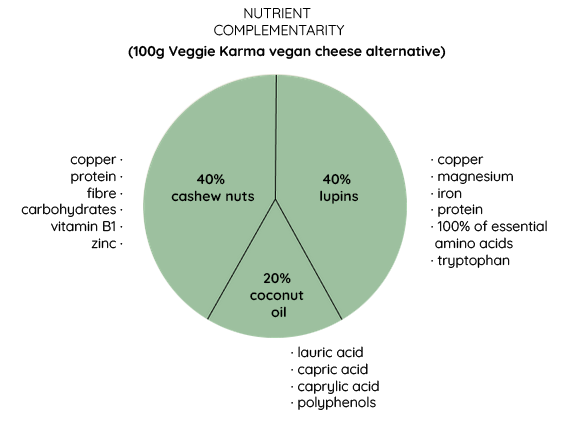
The protein you will find in our products is of high quality, since it combines the amino acids of nuts (cashew nuts) with those of legumes (lupins), complementing each other and creating a complete protein profile, which has nothing to envy to animal protein.

CALCIUM

92mg per 100gr. of semi-cured cheese.

This proportion of calcium is low. To give you an idea, an adult needs about 1000mg of calcium every day. To achieve this, you would have to consume 1kg of our semi-cured cheese. That's a lot... we don't recommend it.

Foods rich in calcium are almonds, hazelnuts, dried figs, chickpeas, white beans, broad beans...

CALORIES

400 Kcal depending on the semi-cured cheese
155 Kcal for the smoked creamy curd.

This is a medium level for the semi-cured and a low level for our soy beverage curd, called “smoked creamy”.

NUTRIENTS

We will find other very interesting nutrients such as complex carbohydrates, dietary fiber, mono- and polyunsaturated fats and of course vitamins and minerals. All these nutrients will be easily digestible and will be better utilized due to the fermentation process with acidophilus to which we subject most of our products.

VITAMINS AND MICRONUTRIENTS in our Karmages

We are very rich in nutrients.

100g of Veggie Karma Karmages contains 19.4% of the recommended intake of iron in women and 43.5% of the recommended intake in men.

We’re not only talking about macronutrients (such as proteins, complex carbohydrates and good quality fats), but also about micronutrients, such as vitamins and minerals that perform essential bodily functions.

There are certain substances present in vegetables that prevent the total absorption of some minerals: we call them antinutrients, more commonly known are phytates. By fermenting our specialities, the phytate content is considerably reduced, thus allowing better absorption of iron, calcium, zinc, selenium, and magnesium by the body, which are five of the minerals that we find in great quantities in our vegan cheese substitutes.

By fermenting our Karmages, the phytate content is considerably reduced, thus allowing better absorption of iron, calcium, zinc, selenium, and magnesium by the body.

We’re not only talking about macronutrients (such as proteins, complex carbohydrates and good quality fats), but also about micronutrients, such as vitamins and minerals that perform essential bodily functions

Our products contain a high content of potassium (470mg) and phosphorus (374mg), as well as the B vitamins (niacin, thiamin, and riboflavin, and B9) and vitamin A.

The NUTRITIONAL PROPERTIES and benefits of a Karmage

Our Karmage are fermented and contain probiotics and prebiotics. This means that, by consuming it, we are promoting the intestinal flora with microorganisms that are beneficial to gut health. It’s vitally important to maintain a healthy microbiota, to improve intestinal health; which also contribute to reduction of the risk of inflammatory diseases, intolerances, allergies, obesity, menstrual cycle diseases, and different types of cancer.

Ingredients contained in our vegan recipes contribute to:

Helping weight control with its high satiating power (fibre and protein) and excellent fat profile.

Maintaining strong bones and muscles by providing calcium, phosphorus, and potassium.

Improving the blood lipid profile by reducing cholesterol and triglycerides, and increasing HDL (good cholesterol).

In addition, the coconut oil it contains is a medium-chain fatty acid (MCT) that helps prevent cardiovascular disease and acts as an anti-inflammatory, which is of particular importance in the diets of athletes.

Reducing oxidative stress, and thus improving longevity and reducing the risk of cancer by providing antioxidant nutrients (copper, anthocyanins, vitamin E).

In short, our Karmages can be eaten as part of a balanced diet. As well as being healthy for you, they’re healthy for the planet, too.

Have we left you wanting to try some? You can check out our recipes here or head over to our online shop here.

Settings

Menu

Please sign in first.

Sign in