

Vegan cheese alternatives and sustainable packaging
Sustainable packaging: The odyssey of getting one to match our artisan vegan cheeses
When we created Veggie Karma, we knew for sure that, in addition to make a gourmet product, we had to ensure that our plant-based cheeses were: healthy, respectful of animals and as sustainable as possible.
Within the environmental sustainability part, packaging plays an important role. The packaging in which we keep our karmajies, the packaging boxes, the glass jars, the chips we use to protect them, the shipping boxes and even the tape to close them. Everything counts. (And everything costs; economically and also at the level of effort. Keep reading and you will understand)
But, before telling you about our adventures, it is worth clarifying some concepts.
What do we call sustainable packaging?
This is a packaging that has a lower environmental impact than conventional packaging. They can be of many types, but they have some of these characteristics:
- They are made from sustainable materials - containers made of paper, cardboard, glass, aluminium or biodegradable or compostable materials.
- They contribute to reducing waste – "eco" packaging is developed in order to reduce the amount of waste generated in the process of its production, use and disposal. This can include the use of reusable or returnable containers, smaller or more compact containers or the elimination of those that are not strictly necessary.
- Contribute to environmental conservation – their production takes into account factors such as reducing greenhouse gas emissions, conserving water and energy, and reducing the use of harmful chemicals.
- They are recyclable – they can be reused and reintegrated into the production chain. This helps reduce the amount of waste generated and conserve natural resources, which are becoming increasingly scarce.
Is biodegradable packaging the same as eco-friendly?
No, biodegradable packaging may be a type of "eco" packaging, but not the only one that exists.
We call biodegradable those containers designed to decompose in the environment in a relatively short period of time, by the action of natural microorganisms, such as bacteria and fungi.
In fact, not even all biodegradable packaging is necessarily sustainable. Some may require specific conditions for their decomposition and release toxic residues into the environment during the degradation process.
In any case, they are more sustainable options than typical plastic containers.
What is the difference between compostable packaging and biodegradable packaging?
Although the words ‘biodegradable’ and ‘compostable’ are often used as synonyms, the truth is that they are not. The difference is that:
Biodegradable products are made with natural and synthetic substances that decompose thanks to the action of microorganisms when in contact with the environment.
On the other hand, compostable products are made entirely from natural materials and are turned into compost by human action. Compostable products take less time to decompose than biodegradable products.
The compost is obtained from the biodegradation of a product rich in organic materials and without any toxic element, so it can be used as fertiliser for plants.
Sustainable packaging we use at Veggie Karma
When it comes to pack our fermented cheese alternatives, we face two challenges:
- The first one: finding a container that would preserve our plant-based cheese alternative for as long as possible. It may sound easy, but it was complicated because we are talking about fermented products that do not contain any kind of preservatives.
- The second one: that the packaging was as sustainable as possible. Starting from the premise that nothing is 100% sustainable, one of Veggie Karma's ambitions has always been to minimize our environmental impact as much as possible.
With this in mind, we've done a lot of research, tried and failed multiple times, to get to what we have today.
The detailed list follows. It is not definitive, because constant improvement is in the DNA of our small company, but for now it fulfils its function:
H3: Compostable bags
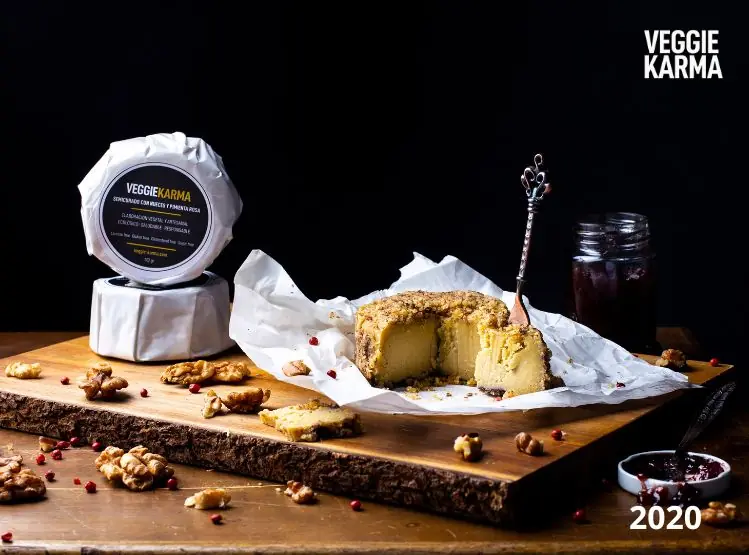
They are the layer in which we "vacuum-wrap" the semi-cured, the Karmesano and the Monella. This is the packing that has given us the most headaches since being in direct contact with the cheeses affects its preservation.
But, it has also made us improve our product. Now our cheese alternatives have a longer aging time than when we started. This, apart from giving them a more intense flavor, has allowed us to incorporate the use of compostable bags.
In our first year of life, we made products that had much more moisture (a bit similar in texture to spreads), which made it impossible to be packed in anything else than plastic.
After starting to cure/age them more, we managed to change the plastic to compostable paper. At the sustainability level it was better, but the shelf life of our babies barely exceeded a month.
This, which seems trivial, affected our ability to expand the market, since many stores did not want to risk buying a new product with such a short expiration date. In addition, since packing in paper is far to be perfect, in some cases mold would appear inside, which caused us a few problems and led us to put more effort into finding another solution.
After many, many searches we had a 'Eureka!' moment. We discovered compostable vacuum bags, which are what we use today. However, the problems have not ended there. If you wonder why, here are several reasons to help you understand how complex everything can be when you are a pioneer in a sector:
Because it is a product that is not in high demand, some of the suppliers we have worked with have had to close because their business was not profitable. (Others we have changed due to poor quality, lousy customer service, delays in delivery times, etc.). So, change has been the constant.
How do we solve it? After packing them, we leave them in the workshop to rest for a week to make sure they are in perfect condition, something that creates space problems and reduces our efficiency a bit. But is it worth it. The affection and enthusiasm with which you describe your experience with Veggie Karma is what motivates us to continue working.
Before moving on to the next chapter, if you know someone who has invented the perfect compostable bag, drop us a line and let us know. It would be quite a discovery.
By the way, to dispose of them, throw them along with other food scraps into the organic waste bin.
Cardboard boxes
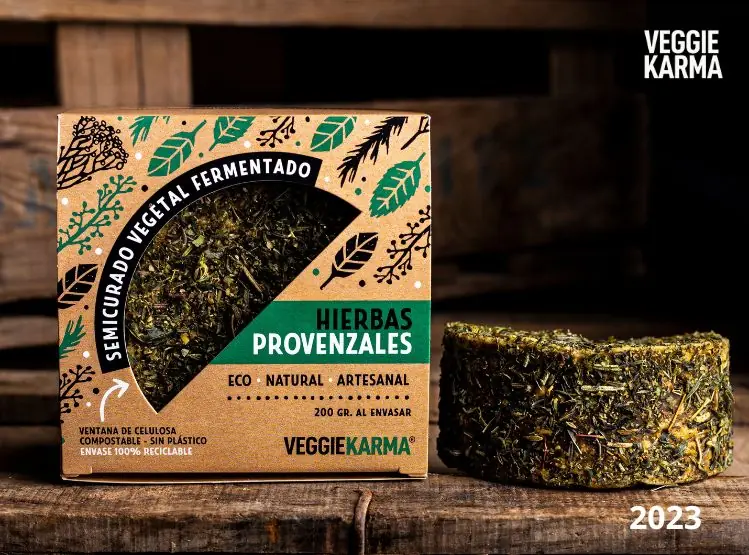
The boxes of our semi-cured cheese alternatives are made of cardboard and therefore can be recycled. Also, we have been lucky to find a good supplier almost since the beginning.
The only thing that has changed is the redesign, of which we are quite proud by the way.
To recycle it, throw it in the cardboard bin.
Glass container
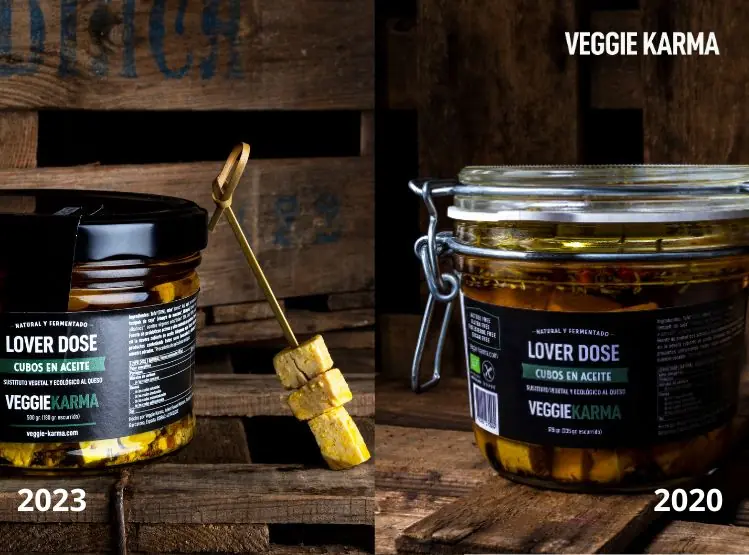
We pack the Lover Dose (our cubes in oil like feta cheese) in a glass jar. At first we started with the typical jars whose lid is attached to the jar with a small aluminium hook.
They were very pretty, recyclable and, as many of our customers told us, they were very good to reuse. However, they were vacuuming so well that it was super difficult to open them. So much so that it became a problem and we decided to change them.
Today we use the typical screw-top glass jar, which comes closed with an aluminium lid. It is not as pretty as its predecessor, but it is more practical.
It is recycled by throwing it into the glass container, without the lid. This has to go to the yellow container, the one for plastic.
Renature Filling Chips
These are the small "balls" that we put in the boxes when we ship the Lover Dose. They create a strong protective padding that is resistant to vibrations and prevents the glass jars from breaking.
Most of these types of packaging chips are made from polystyrene, a petroleum-derived synthetic plastic that is non-biodegradable and takes hundreds of years to break down in the environment.
It is true that they can be reused and thus reduce their environmental impact, but their production requires large amounts of energy and resources, something contrary to the philosophy of Veggie Karma.
Instead we have opted for Renature Chips, which have a higher price, but are 100% biodegradable, compostable and waste-free. In fact, they dissolve in water, so the you can easily throw away with organic waste.
Bubble wrap
Another solution to protect the glass is bubble wrap and it is something we use occasionally. BUT, we do it to reuse it. So, for those of you who have given us a call when you received it, here is the explanation.
Some of the shipments we receive from our suppliers are wrapped in this type of material. (Something that unfortunately is beyond our control). Although we are aware that it is not very eco-friendly, our way of making it more sustainable is to reuse it.
Instead of throwing it away and contributing more to the problem, we decided to reuse it and be part of the solution. Our advice is to do the same. Save it and use it when you need to protect something fragile.
Scotch tape
To close the cardboard boxes in which we ship our orders, we use adhesive tape made of kraft paper, a strong and durable type of paper made from wood pulp.
Unlike other adhesive tapes, kraft paper tape does not contain plastics and is biodegradable, which makes it more respectful with the environment.
In addition, it adheres very well to the cardboard surface and can be easily torn by hand, without the need for scissors. This way it will take even less time to open those plant-based cheese alternative boxes that you fancy so much and you will be able to savor them without unnecessary delays.
Conclusion
In addition to making healthy products with a scrumptious flavor, at Veggie Karma we are concerned with minimizing our environmental impact. For this reason, 100% of the packaging we use is the most sustainable solution we have been able to find.
We know that we can always continue to improve in all aspects, so we are always aware to the opinions of our clients and friends. If you want to make any comments or suggestions related to our packaging or our plant-based cheeses, remember that you can write to us at contact@veggie-karma.com or through our Instagram account @veggiekarmafood.com
Join us and #ChangeKarma
Posted in:
News
Related posts
-
 Fair Trade Cashews: Our Ethical Choice
At Veggie Karma, we only use ethically-sourced cashews to create our vegan cheese substitutes. If you want to know...Read more
-
What is tofu and what are its secrets?
Goal: to find out all about tofu; its nutritional value, origin, varieties, and why tofu isn’t always necessarily...Read more
-
Lactose-free cheese and other cheeses that intolerants can enjoy
Have you ever suffered from gas, stomach cramps, nausea, abdominal pain, or diarrhea after consuming dairy...Read more
-
5 vegan appetizers for christmas
Do you want to eat your VK cheese in a different way? Here are some simple, quick and delicious recipes.Read more
-
Lupins: Properties, benefits and inconvenients
Did you know that lupines contain more protein than soya? Or that they help to reduce blood sugar levels? Read on,...Read more
Leave a comment
Login to post comments