

Is pesto vegan? Ingredients and how to choose it
Is pesto vegan? Ingredients, Parmesan alternatives and how to choose a good one
Pesto has become so popular that it no longer lives exclusively on top of a bowl of pasta.

Is pesto vegan? The short answer is yes and no
It has found its way into sandwiches, salads, dressings, toast, pizza, roasted vegetables and even risotto. In short, pesto has gone out to see the world.
And the more we use it, the more people ask the same question: is pesto vegan? Pesto can be entirely plant-based, but traditional pesto is not usually vegan.
The reason comes down to two ingredients that are very easy to overlook: Parmesan and Pecorino. Let us look at what this sauce really contains, how to make it plant-based without taking away its soul, and what to check when choosing a jar.
What exactly is pesto?
Pesto is an uncooked sauce made by pounding or blending aromatic ingredients with oil. Its name does not actually refer to basil: it comes from the Genoese verb pestâ, meaning to pound or crush in a mortar.
That is why we can have rocket, sun-dried tomato, pistachio, olive or artichoke pesto. But when we simply say “pesto”, we are usually thinking of its best-known form: Genoese basil pesto.
What is in traditional pesto?
The official World Pesto Championship recipe combines Genoese basil, extra virgin olive oil, pine nuts, garlic, salt, Parmigiano Reggiano and Fiore Sardo, a Sardinian Pecorino.
Every ingredient has a job. Basil brings fragrance and freshness. Oil carries and binds the flavours. Pine nuts provide body. Garlic keeps everything in order — or creates complete chaos if we get overexcited — while the cheeses add saltiness, richness and depth.
Cheese is not a modern addition dreamed up by a factory to annoy vegans. It belongs to the traditional recipe.
Why isn’t traditional pesto vegan?
First, because Parmesan and Pecorino are made from milk. Second, many traditional cheeses use animal rennet. Pecorino Romano, for example, is coagulated with lamb rennet.
Traditional pesto is therefore not vegan and, depending on the cheeses used, may also be unsuitable for vegetarians who avoid animal rennet.
The good news is that everything else is already plant-based. There is no need to dismantle pesto completely and rebuild it with parts from another piece of furniture. We simply need to recover what the cheese contributed: saltiness, body, creaminess and the deep flavour that makes another spoonful seem perfectly reasonable.
“The colour of pesto does not tell you whether it is vegan. The ingredients do.”
Does all green pesto contain cheese?
Not necessarily. Fully plant-based green pestos do exist. Some recipes replace cheese with nuts, nutritional yeast, miso or a fermented plant-based alternative; others simply leave it out and rebalance the salt and oil.
Words such as “traditional”, “Italian” or “Genoese” are not enough either. To know what we are buying, we need to turn the jar around and read the ingredients. Admittedly, studying labels in the middle of a supermarket is not exactly the Mediterranean dream, but it can reveal some interesting things.
Is red pesto vegan?
We cannot assume that either. Pesto rosso is generally made with sun-dried tomatoes, oil, nuts, garlic and herbs, but many recipes also contain Parmesan, Pecorino or another cheese.
The same rule applies to rocket, pistachio, artichoke and olive pesto: the name and colour are not enough; the ingredient list decides.
How can Parmesan and Pecorino be replaced?
The aim is not merely to remove dairy ingredients. We need to replace their function. Nutritional yeast brings toasted notes; miso provides saltiness and fermentation; nuts and seeds give body; and a fermented Italian-style plant-based alternative can add some of the complexity of an aged product.
There is no single correct answer. Basil, oil, garlic and salt make a light, fresh pesto. Nuts give it more body. A fermented ingredient creates a deeper, longer-lasting flavour.
Cashews: the king of substitutions
If one ingredient deserves a little crown, it is the cashew.
Cashews can replace some or all of the pine nuts while adding a creamy texture reminiscent of cheese. Their flavour is gentle enough to let basil remain centre stage. They have personality, but know when to step aside and let somebody else shine — an admirable quality both in and out of the kitchen.
When combined with a fermented plant-based alternative, they bring two different dimensions together: the creaminess of cashews and the aromatic depth of fermentation.

Cashews bring creaminess while Karma.sano adds the depth of fermentation.
“Cashews bring creaminess. Fermentation brings depth.”
What does “vegan Parmesan” really mean?
“Vegan Parmesan” is what many people type into Google when looking for an intense, salty, slightly aged plant-based product to grate over pasta, rice, pizza or salads. We all understand exactly what they hope to find.
In the European Union, however, dairy designations cannot be freely used to market wholly plant-based products. Parmigiano Reggiano is also a Protected Designation of Origin, and the term “Parmesan” is protected as well.
That is why we describe Karma.sano for what it is: a fermented Italian-style plant-based alternative for grating. It provides the culinary qualities people are looking for — intensity, fermentation and umami — without dairy ingredients.
The easiest trick for choosing good pesto
Here is something genuinely useful when shopping: under European law, ingredients are listed in descending order of weight at the time the food is made.
THE FIRST INGREDIENT IS THE ONE USED IN THE LARGEST AMOUNT
Basil comes first: the recipe genuinely revolves around basil.
Oil comes first: check how much basil the product actually contains.
If we want basil to be the star, it makes sense to find it near the beginning. Oil appearing first does not automatically make a pesto bad — it also plays a major role in the traditional recipe — but a pesto built around basil is not the same as a sauce built mainly around oil.
We can also check whether the oil is clearly identified, how much basil is included, which nuts are used, whether the texture comes from the ingredients themselves or a long list of starches and thickeners, and whether the flavour comes from real foods and fermentation or mainly from flavourings.
Why choose organic pesto?
It takes a lot of basil leaves to fill a jar of pesto. When we consume a plant almost whole and finely blended, it makes sense to think about how it was grown.
Choosing organic ingredients does not mean that every conventionally grown food is unsafe. Pesticide residues are regulated and monitored in Europe. Organic farming is not magic either, nor does it mean that no crop treatment is ever used.
It does, however, place much tighter restrictions on synthetic pesticides and forms part of an agricultural model designed to protect biodiversity, soil fertility, water and natural balances. To us, that choice matters even more when the main ingredient is fresh basil leaves.
We also know that price matters. A lot. Our 130 g organic pesto costs €4.99. We worked to keep it below five euros so that choosing organic basil, extra virgin olive oil and quality ingredients would not turn a simple bowl of pasta into a high-risk financial decision.
How to make vegan pesto at home
For a simple recipe, use 50 g fresh basil, 40 g cashews, 30–40 g Karma.sano, around 80 ml extra virgin olive oil, one small garlic clove and a pinch of salt.
Wash and dry the basil thoroughly. Blend the cashews and garlic first, then add the leaves, Karma.sano and some of the oil. Blend briefly and add the remaining oil gradually until the texture is right.
Do not blend for too long: the heat can darken the basil. Taste before adding more salt, too. Karma.sano already brings intensity, and charging in with the salt shaker can end in a minor Ligurian tragedy.
Pesto is not just for pasta
We love pasta, but asking pesto to do one job for its entire life seems terribly unfair.
Try it in a roasted vegetable sandwich, on tomato toast, pizza, potato salad, rice, risotto, soup, salad dressing, savoury pastries, pulses or as a dip. Adding it at the end of cooking preserves more of basil’s fresh aroma.
If a little remains at the bottom of the jar, add a splash of oil, shake well and you have an instant dressing. Nobody gets left behind here.
Giovanni, Sardinia and a jar that had to be good
Giovanni is Sardinian, and his mother is a passionate cook. She is also very fond of pesto, which is a fairly important detail in this story.
With that family heritage, Giovanni could hardly turn up one Monday with a jar of green sauce and say, “That’ll do.” He worked seriously hard to create a plant-based pesto that respected the essentials: plenty of fresh basil, good extra virgin olive oil and the depth traditionally provided by Parmesan and Pecorino.
To achieve it, we use Karma.sano, our fermented Italian-style plant-based alternative for grating.
“As far as we have been able to establish, Veggie Karma is the first European brand to make a basil pesto with a fermented Italian-style plant-based alternative.”
We did not add it for a clever line on the label. We added it because fermentation creates depth, persistence and umami.
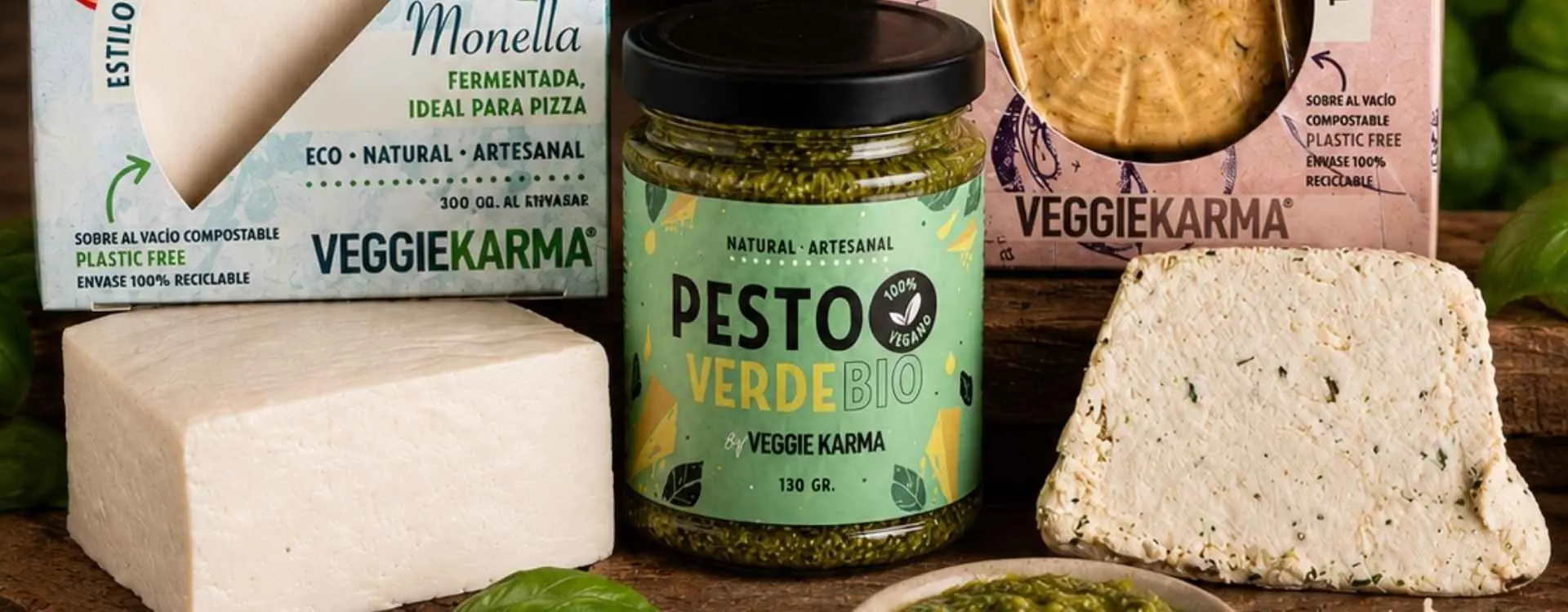
Our pesto is 100% plant-based, organic and gluten-free. Fresh basil comes first on the ingredient list because, when making basil pesto, it seems only fair to let the basil have something to say.

Veggie Karma organic plant-based pesto, made with fresh basil and Karma.sano.
“We did not want to make a green sauce without dairy. We wanted to make good pesto. Being plant-based should not mean having to apologise for anything.”
Vegan pesto: frequently asked questions
Is traditional pesto vegan?
Usually not. The traditional recipe contains Parmigiano Reggiano and Pecorino.
Does pesto contain lactose?
Traditional pesto contains dairy ingredients. Anyone who must avoid dairy completely should choose an explicitly plant-based pesto and always read the label.
Is pesto vegetarian?
It depends on the cheeses used. Some are made with animal rennet.
Does plant-based pesto contain gluten?
The basic recipe does not need it, but always check the label. Veggie Karma pesto contains no gluten.
Can pesto be made without pine nuts?
Yes. Cashews, walnuts, almonds, pistachios and certain seeds can replace them.
Can pesto be frozen?
Yes, preferably in small portions. Its texture may change slightly.
How long does it keep after opening?
That depends on the recipe and processing method. Keep it refrigerated and follow the instructions on the label.
So, is pesto vegan?
Traditional pesto generally is not. But it certainly can be, without becoming a sad, watery or apologetic version of the original.
With good basil, extra virgin olive oil, cashews and a fermented plant-based alternative, pesto can be creamy, aromatic and full of flavour.
Would you rather enjoy it without getting the blender out?
Discover our organic pesto, made with fresh basil and fermented Karma.sano.
DISCOVER OUR PLANT-BASED PESTODo you enjoy discovering what is really behind your food?
Subscribe, receive 5% off and do not miss our next articles.
Posted in:
News
Related posts
-
 Fair Trade Cashews: Our Ethical Choice
At Veggie Karma, we only use ethically-sourced cashews to create our vegan cheese substitutes. If you want to know...Read more
Fair Trade Cashews: Our Ethical Choice
At Veggie Karma, we only use ethically-sourced cashews to create our vegan cheese substitutes. If you want to know...Read more -
What is tofu and what are its secrets?
Goal: to find out all about tofu; its nutritional value, origin, varieties, and why tofu isn’t always necessarily...Read more
-
Lactose-free cheese and other cheeses that intolerants can enjoy
Have you ever suffered from gas, stomach cramps, nausea, abdominal pain, or diarrhea after consuming dairy...Read more
-
5 vegan appetizers for christmas
Do you want to eat your VK cheese in a different way? Here are some simple, quick and delicious recipes.Read more
-
Lupins: Properties, benefits and inconvenients
Did you know that lupines contain more protein than soya? Or that they help to reduce blood sugar levels? Read on,...Read more
Leave a comment
Login to post comments