


Lupins: Properties, benefits and inconvenients
Love lupins for their properties and enjoy them like never before in our plant-based alternatives to cheese
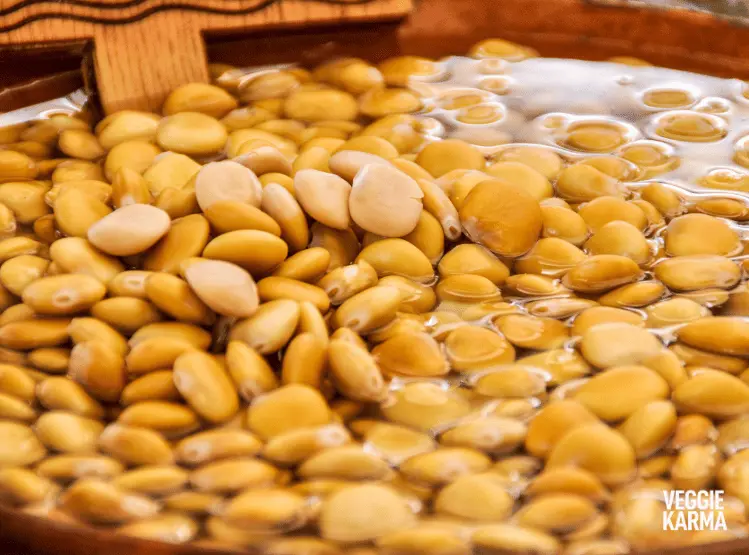
At the last Biocultura fair in A Coruña, many of you were surprised that lupins are one of the main ingredients of our alternatives to cheese. Yes, it may sound strange, especially since we are the only ones (that we know of) that incorporate the popular 'lupinus' into our recipes.
You have asked us why and here is our answer.
Firstly, because lupine is a legume that has many properties and benefits for health (you can read them all below).
Second because, unlike cashews, lupins are a local product. As it is grown in Spain, the distance from our suppliers to our workshop is shorter and helps us reduce our environmental impact. Carefull! We are talking about the Lupinus Albus, or white lupine, which is the one we use.
And third, but not least. Because it's delicious! Alone and also as part of our plant-based cheese alternative
 < /p>
< /p>
What properties do lupines have?
Regarding their properties, lupins are a very complete food. Let's see their nutritional values per 100 grams. To do so, we are going to use the data published by the FEN (Spanish Nutrition Federation) in its report on legumes prepared jointly with the AESAN (Spanish Nutrition Agency). Food Safety and Nutrition).
If you want to go deeper into the subject, download here the Report on Legumes, Nutrition and Health.
We have also used the Food Data Central, published by the United States Department of Agriculture, a tool we recommend you have on hand, if you are interested in knowing the nutritional value of lupines or any other food.
Protein:
In general, legumes are characterized by their high protein content, much higher than that of cereals. But, within legumes, lupins far exceed all their competitors, soybeans included. Yes, a very little difference, but it seems unfair that soybeans are the queen of vegetable protein, when a local product such as lupine offers a very high percentage of this molecule, which is so important for the body.

There is no doubt that legumes are the main vegetable protein source. And, although it is a source of good-quality protein, it is true that it has its limitations in terms of sulfur-containing amino acids (cysteine and methionine), which are two of the Essential amino acids that are found in animal protein sources and that are necessary for the body.
So, if you are vegan or vegetarian, ideally, consume legumes in combination with cereals to make them a complete food. But, since our body is a very intelligent machine, it accumulates amino acids and administers them throughout the day. This means that it is not necessary to combine cereals and proteins in the same meal. You can have a bowl of cereals for breakfast and have some lentils with vegetables for lunch, the result will be the same.
Fiber:
Like the vast majority of legumes, lupins are rich in dietary fiber, particularly soluble fiber. This type of fiber dissolves in water and turns into a gel during digestion, which slows down the digestive process and manages to provide a feeling of satiety. A feature that can be very beneficial for those who want to lose weight.
It can also help lower “bad cholesterol” as well as blood pressure and inflammation. This is something that we will see in more detail a little further down, in the section 'Health benefits of Lupins'.
The only bad thing is that it is also responsible for producing flatulence, something that can be reduced by soaking the legumes before cooking.
For its part, the insoluble fiber is mostly eliminated through the feces, thus improving intestinal transit.
Raw lupins provide around 19g of dietary fiber per 100. A much higher amount than foods traditionally considered rich in fiber such as: oats (6g), asparagus (1.5g) or apples (2.4g).
And in case you are wondering, the legumes with the highest amount of fiber are white and black beans, which exceed 25g per 100.
Minerals:
Lupins are an excellent source of minerals. It stands out above all for its high level of Calcium and Zinc, although it also contains Iron, Magnesium, Phosphorus, Potassium and Sodium.
In fact, lupine is the legume with the second highest amount of calcium (176mg per 100g), surpassed only by soybeans, with 240mg.
And, if you are low in Zinc and follow a vegetarian diet, with its 4.7mg per 100g lupins are your best ally when it comes to replenishing this mineral.; Having a low level of Zn can cause, among other things, tiredness, memory problems or it is easier to catch colds.
Vitamins:
Like other legumes, lupine is an interesting source of vitamins, mainly those of the B group. Thiamin (B1), Riboflavin (B2), Pyridoxine (B6) and, above all, Niacin (B3) , are the ones that have a greater presence in the composition of the Lupinus.
If it also contained B12, it would be worthy of making a monument to it, especially among vegans, but unfortunately, and despite what some articles circulating on the internet claim, no trace of it. Perfection does not exist…
Other vitamins that you can find in lupins are Folates and Vitamin C.
Fats:
Each 100g of raw lupins contain just under 10g of fat, which is considered a moderate to low amount. In addition, most of these fats are monounsaturated and polyunsaturated (omega-3 and omega-6) , that is, those that are considered good for health.
Like other foods of plant origin, they do not contain cholesterol.
Do lupins make you fat?
It is a question that some of you have asked us and the answer is, as always, 'It depends'. In principle it shouldn't, since a 100 g of lupins has only about 120 kcal and its fat content is on the low side.
In addition, due to the amount of soluble fiber they contain, you will feel full quite quickly. In general, it is a healthy food, with good nutritional properties, including a high level of vegetable protein.
But it all depends on the type of diet you're following, the level of physical activity you do, the amount of lupins you decide to take and, of course, what you accompany them with . If you drink several beers with this delicious appetizer, the calories will go up and so will your weight.
Nothing in excess is good, not even lupins. A balanced and varied diet is the key not only to maintain your weight, but also your health.
And speaking of health, let's see what are the positive effects of this seed.
Want to discover lupins in a whole new way?
Our fermented plant-based semi-cured alternatives are made with 30 % lupins. Leave us your email and receive 5 % off to discover them.
Data controller: Barcelona Veggie Crafters SL. By subscribing, you agree to receive your discount and news from Veggie Karma. We do not sell or share your data for commercial purposes; only service providers required to manage our emails have access to it. You can unsubscribe at any time. Data protection.
Already have your discount? Discover our plant-based semi-cured alternatives.
Benefits of lupins for your health
At Veggie Karma we are such huge fans of this food that, unfortunately, is losing prominence in the Mediterranean diet. So much that we want it back in fashion.
However, we are not blinded by its properties and benefits. For this reason, the ones you will find below are contrasted and are based on scientific evidence.
Diabetes
More and more research suggests that legumes reduce blood glucose levels and play an important role in the prevention and even treatment of diabetes mellitus.
In fact, in a study published in 2011, (The 3 R's of Glycemic Index: Recommend tions , Research, and the Real World), doctors Amanda Kirpitch and M.Maryniuk affirm that the consumption of three or more servings of legumes per week reduces up to 35 % the risk of suffering from this disease.
Lupin, in particular, has been the subject of several studies for its anti-diabetic properties. One of them, led by Dr. Marcello Durante of the University of Milan, has revealed that a protein found in lupins could provide a cure for diabetes.
This protein, known as 'gamma conglutin', has demonstrated its ability to lower blood glucose and to effectively control the insulin level produced by the body.
Cholesterol
Although until recently it was believed that soybeans were the only legume directly involved in lowering blood cholesterol, recent studies have found that peas and lupins also have these properties. Especially the first ones.
A study conducted in 2013 by the Department of Nutrition at the University of Jena, Germany, concluded that, lupine protein is capable of significantly reducing LDL cholesterol, also known as 'bad cholesterol', in the short term.
And, although he is not the only one who reaches this type of conclusion, there is still a lot to be investigated. Both lupine and other legumes can be a booster to lower cholesterol, but this should not mean giving up medical treatment or a healthy lifestyle.
How to eat lupins to lower cholesterol?
Although there is no scientific evidence in this regard, on the internet information abounds about how and how much lupine to take to lower cholesterol.
Neither taking three dry lupines daily, nor taking them cooked on an empty stomach, nor even taking it while saluting the sun will improve its effectiveness.
It is true that, like all legumes, lupins lose part of their protein when cooked. And if your 'weapon' to lower cholesterol is in your proteins, logic would indicate that eating them raw would be the best option. But there is no scientific study to support this claim.
Constipation
There are no specific studies that have investigated the relationship between eating lupins and constipation. But there are studies about the intake of legumes in general and the regularity to expel feces.
This study published in 2017 concluded that 100 g of cooked legumes per day cover almost 30% of the daily fiber needs of an adult.
With 19 g per 100, lupins are one of the richest legumes in dietary fiber, just below beans (both white and pinto). In addition, they also contain interesting amounts of zinc, potassium, folates and vitamin B6, nutrients that help improve intestinal transit.
Intestinal flora
This study has shown the changes that occur in the microbiota or intestinal flora when incorporating lupins into our diet. To be specific, its intake increases the presence of Bifidobacterium spp, probiotics that help with intestinal disorders and are known as 'good bacteria'.
Pregnancy
Folate (folic acid or vitamin B9) is important for women who want to get pregnant and for those who are already pregnant. Its deficiency can cause serious malformations in the fetus, some of them incompatible with life.
The recommended daily amount of folate for an adult is 400 micrograms and the World Health Organization estimates that a pregnant woman should increase the dose to 800 – 1000 µg.
Lupin seeds provide a large amount of Vitamin B9 (355 µg per 100g when raw), as well as other vitamins and minerals such as calcium and iron , beneficial for mother and baby.
The View
Eating lupins has no effect on the eyesight. We name it because there are several pieces of information that mention it, referring to its vitamin A content. And yes, vitamin A is important for vision function. It participates in the production of the pigments that make up the retina and helps protect the cornea. However, it is a vitamin that is not found in any of the plants in the Lupinus family. We're sorry! Not a trace of vitamin A in the lupine.
Contraindications of lupins
It happens with all the legumes and the lupine was not going to be less. Depending on the amount consumed and each organism, the flatulence they cause can be quite annoying. But, its nutritional benefits far outweigh this problem, so don't let it put you off.
The other big problem is that most of the time we eat lupins we do it in brine, which causes its salt content to rise to unadvisable levels, especially for hypertensives .
The solution? Desalt them by putting them in water for at least an hour before consumption.
How should lupins be eaten?
The dried lupins need at least 24 hours of soaking. Then, they are boiled for about 20 minutes in a pressure cooker. The last step is the longest and most tedious. You will have to put them in salted water for about a week and change the brine twice a day. In this way they will lose that bitter taste that makes them inedible.
If the process seems like a nightmare, you can also buy them at any supermarket, ready to use. If you do, our advice is to put them in water an hour before consuming them. This way they will lose excess salt and be much healthier.
Now you can eat them as appetizers or use them to make interesting recipes such as vegan mayonnaise, salads, stir-fries, hummus and even croquettes . (If you want help with any of these recipes, leave us a comment below and we'll do a post about lupine recipes.)
But, if you want a very original way to eat lupins, you can't miss the alternatives to vegetable cheese from Veggie Karma. All our semi-cured cheeses alternatives have lupine as the main ingredient. Try them! You too will become a #LupinLover.
Posted in:
News
Related posts
-
 Fair Trade Cashews: Our Ethical Choice
At Veggie Karma, we only use ethically-sourced cashews to create our vegan cheese substitutes. If you want to know...Read more
Fair Trade Cashews: Our Ethical Choice
At Veggie Karma, we only use ethically-sourced cashews to create our vegan cheese substitutes. If you want to know...Read more -
What is tofu and what are its secrets?
Goal: to find out all about tofu; its nutritional value, origin, varieties, and why tofu isn’t always necessarily...Read more
-
Lactose-free cheese and other cheeses that intolerants can enjoy
Have you ever suffered from gas, stomach cramps, nausea, abdominal pain, or diarrhea after consuming dairy...Read more
-
5 vegan appetizers for christmas
Do you want to eat your VK cheese in a different way? Here are some simple, quick and delicious recipes.Read more
-
Vegan cheese alternatives and sustainable packaging
Without plastic, recyclable, biodegradable... Discover what types of ecological packaging exist and what are the ones...Read more
Leave a comment
Login to post comments